


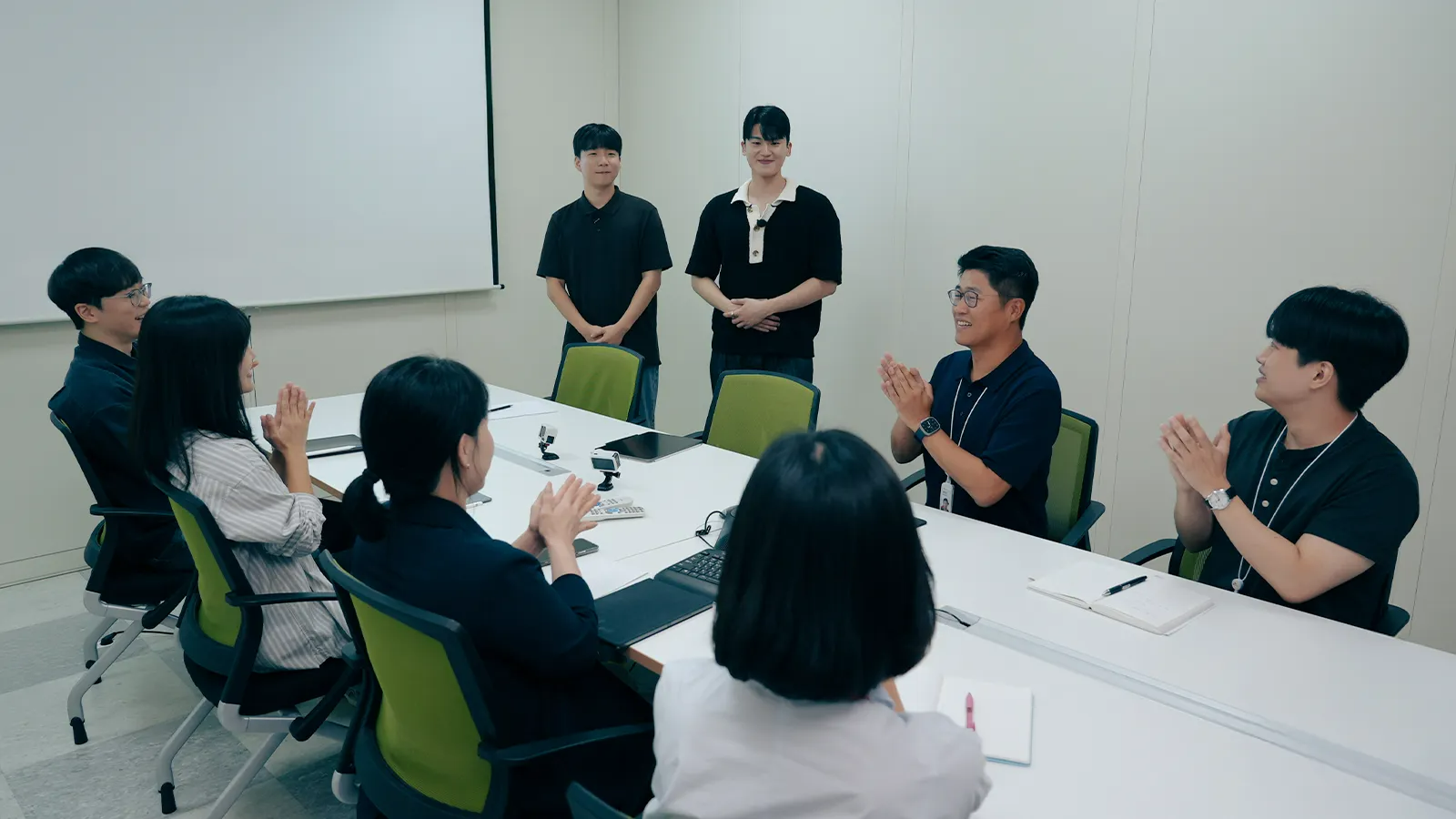
Before a semiconductor can be deemed “development complete” and advance to mass production, it must pass through a critical stage of performance verification, product refinement, and quality assurance to ensure it is ready for high-volume manufacturing. This is where Product Engineering, or PE, comes in. The Newsroom, joined by Student Ambassadors of SK hynix Donghwan Kim and Gihong Cho, spoke with Hyunjun Hong (TL, PKT PE) and Hyosun Park (TL, Computing PE) to explore the role and core value of PE—an essential link in the semiconductor development journey.
Bridging Development and Mass Production Through Performance Verification and Yield Optimization—PE
PE leads verification and improvement throughout the entire process—from planning and design to prototype evaluation and mass production environment setup—to ensure that developed products can be produced reliably in actual mass production environments. In this sense, PE serves as a “bridge” between semiconductor development and mass production. PE’s core responsibilities include data-driven quality verification and failure analysis, test condition optimization, and yield improvement. However, these responsibilities differ in purpose and role from testing performed during the mass production stage. While Mass Production Technology (P&T) is responsible for stabilizing and improving the efficiency of high-volume manufacturing, PE focuses on verifying whether the manufactured chips operate as intended. Its role is centered on enhancing the product’s overall maturity from the development stage onward. PE can be divided into three main areas: Test Engineering, Test Characterization, and Product Verification. Among these, Test Engineering is responsible for designing and optimizing the test conditions that serve as the foundation for quality verification. It is further divided into Wafer Test, which identifies defects at the wafer stage, and Package Test, which verifies chip-level characteristics after packaging. Package Test also involves more detailed checks of cell-level defects and speed characteristics. Test Characterization further enhances product performance and quality through application failure analysis, test program development, and big data mining. Product Verification is the stage where design and process characteristics are thoroughly verified. In collaboration with design and process engineers, PE analyzes defect phenomena and identifies directions for improvement.



Who We’re Looking For
Positioned at the intersection of development and mass production, PE works closely with a wide range of teams. In the early stages of development, PE engineers collaborate with design and process engineers to analyze failure patterns and identify improvement measures. When prototypes are mounted on application boards, they work closely with Application Engineers, or AEs, to identify potential failures in real-world application environments. As product development nears completion, they collaborate with Mass Production Technology (P&T) engineers to set up the test environment for mass production, focusing on achieving the right balance between quality and efficiency. In the PE role, testing ultimately involves balancing quality assurance with efficiency. Increasing test coverage or granularity and extending test time can improve quality, but it may also delay development schedules or lower production efficiency. On the other hand, focusing only on efficiency increases the risk of missing defects. Striking the right balance between these two priorities is one of PE’s key responsibilities. For this reason, the PE role requires both technical expertise and problem-solving skills. PE engineers need not only an understanding of semiconductor device physics and the semiconductor industry as a whole, but also strong data analysis capabilities grounded in the fundamentals of electronics, physics, and statistics. They must also be able to interpret test data and accurately identify the root causes of defects. Because the role involves collaboration with many different departments, clear communication and the ability to provide well-reasoned feedback are also essential. “The role of PE, which was once limited to quality verification and yield improvement, is now expanding into a more advanced technical role that requires data-driven insight, customer-specific optimization, and sophisticated analytical capabilities,” said Sangmok Song (TL, Talent Acquisition). “In particular, amid changes in the semiconductor industry such as scaling, higher integration, and increasingly specific customer requirements, PE is evolving into a key role that drives optimization tailored to customer’s actual usage environments.” He added, “We look forward to your continued interest in and support for the PE role, which will play a strategic role directly linked to SK hynix’s business growth.”


Q. Could you briefly introduce yourselves?
Hyunjun Hong (TL): I am a test engineer in the PKT PE Team, where I focus on analyzing speed-related failures in packaged chips. Hyosun Park (TL): I work in the Computing PE Team, which is responsible for developing new computing products. I conduct speed testing and failure analysis to help ensure product performance and improve overall quality.
Q. What is the main objective of the PE role, and how do you work toward achieving it?
Hyunjun Hong (TL): The primary goal of PE is to deliver high-quality products within a short timeframe through efficient testing. If defective materials are not quickly and accurately screened out during the testing process, it can delay the overall schedule and affect yield. For this reason, we continuously explore various testing methods to improve efficiency and strengthen product competitiveness. Hyosun Park (TL): I believe the PE role has two key objectives: achieving the highest level of product quality within the shortest possible test time, and establishing an optimized test baseline for stable mass production quality. To achieve these goals, we maximize test coverage to ensure that no specification requirements are missed. We also conduct regular specification review sessions to identify newly added or updated functions and incorporate them into our test items.
Q. What qualities and skills do you look for in new hires for PE roles?
Hyosun Park (TL): A broad understanding of semiconductors is definitely helpful, as PE requires knowledge across a wide range of areas, from design and devices to process technology. Programming skills are also important for running tests. Since the equipment we use is based on C, having a basic understanding of C programming can be a big advantage when operating the equipment. Hyunjun Hong (TL): That said, even if you have limited programming experience, there’s no need to worry too much. After joining the company, new PE hires go through a four-month training program called “PE School,” where they learn the fundamentals of the role as well as how to use the equipment. There are also various internal training programs available to help employees strengthen any areas where they may need further support. More than anything, I think the most important qualities are persistence and a never-give-up attitude—the willingness to keep digging, even when failure analysis does not immediately lead to a clear answer.
Q. What advice would you give to anyone interested in pursuing a PE role?
Hyosun Park (TL): PE offers many opportunities to learn by working with a wide range of teams across the company. It is a role that allows you to grow through close collaboration with others. For those preparing to apply, PE may seem a bit more challenging or less familiar than other roles. I hope the insights I shared today will be helpful as you prepare. Hyunjun Hong (TL): One of the greatest appeals of this role is the sense of accomplishment that comes from helping improve product quality. It also allows you to build broad knowledge by working with various failure cases. Because the role requires an understanding of design, devices, and processes, the company has strong training programs in place to help you develop the knowledge needed for the job. Even if the preparation process feels overwhelming at first, I hope you will not worry too much and will approach the challenge with confidence.